Posts

POLYNOMIALS

Image
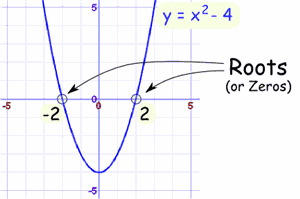
Oxford dictionary definition: An expression of more than two algebraic terms , especially the sum of several terms that contain different powers of the same variable(s ). Cambridge dictionary definition: A number or variable ( = mathematical symbol ), or the result of adding or subtracting two or more numbers or variables. A polynomial is an algebraic expression in which the variables have non-negative integers exponent only and involves the operations of addition, subtraction, multiplication. Examples are x^2 + 3x + 4,  4x^2 - 6x^2y^2 + x^3 + 7y^3 etc.  The zeroes of polynomial are precisely the x-coordinates of the points, where the graph of y = p(x) intersect the x-axis. The linear polynomial ax + b, a is not equal to zero, has exactly one zero. Quadratic polynomial can have either two distinct or two equal zeroes or no zero. This implies the polynomial of degree 2 has atmost 2 zeroes. Polynomial of degree 3 ( cubic polynomial ) can have atm...
FUNDAMENTAL THEOREM OF ALGEBRA

Image
Fundamental theorem of algebra states that every non-zero, single variable polynomial of degree n with complex cofficients has exactly n complex roots. Fundamental theorem of algebra is also stated as, every non-constant single-variable polynomial with complex cofficients has at least one complex roots. This also comprises polynomial with real cofficients because every real number is a complex number with imaginary part equal to zero.

FUNDAMENTAL THEOREM OF ARITHMETIC

Image
Fundamental theorem of arithmetic is also called as unique factorization theorem or the unique prime factorization theorem. Definition of fundamental theorem of arithmetic: Every Integer  greater than 1 can be factored into a product of primes in exactly one way ( aside from rearranging the factors ). Example 24=2*2*2*3. The requirement of the factors to be prime is necessary. The theorem explains why 1 is not considered prime. If 1 would be prime, factorization would no longer be unique e.g. 4 = 2*2 = 2*2*1 = 2*2*1*1. This theorem explains that every integer greater than 1 is either prime or is the product of prime numbers, and the product is unique.

REAL NUMBER AND COMPLEX NUMBERS

Real numbers are the collection of rational and irrational numbers. Real numbers can be represented using a real number line. In general natural numbers, whole numbers, integers, rational and irrational numbers, all are real numbers.  A complex number is a number of the form a+b i , where a and b are real numbers and i is the imaginary unit such that i ^2= -1 All the real numbers are complex numbers with imaginary part equal to zero.

PRIME NUMBERS AND COMPOSITE NUMBERS

Image
Pime numbers : Positive integer greater than 1 that is divisible only by one and itself. Examples of prime numbers are 2,3,5,7,11 etc. Composite number: Positive integer having factors other than 1 and itself. In general, positive integer which is not prime is compostive. Examples are 4,6,8,10,12 etc.  0 and 1 are niether prime nor composite.

EVEN AND ODD NUMBER

Even numbers: An even number is an integer divisible by two. Even numbers are either positive or negative. Zero is an even number. Odd numbers: An odd number is an integer not divisible by two. Odd numbers could be either positive or negative. 1 is the first positive odd number.

IRRATIONAL NUMBERS

Image
Irrational numbers can be defined as: A number is an irrational, if it has a non-terminating and non repeating decimal representation. An irrational number can't be written in the form p/q, where p and q are integers and q is not equal to zero. All the square root of natural numbers are irrational other than perfect squares.