Posts

MATHEMATICS OF EARTH
Image
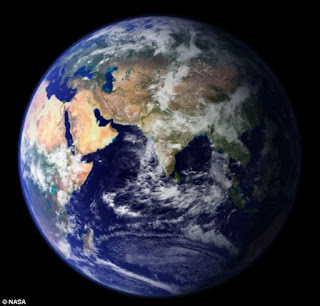
Earth Fact Sheet Our Earth is the only planet known to have life supporting environment and is the third planet from the sun. The Earth has only one natural satellite i.e. our Moon. An Earth year is about 365.26 days long. 71% of the Earth surface is covered with water and the land constitute only 29% of the Earth surface. Bulk parameters Mass (10 24 kg)                 5.9723 Volume (10 10 km 3 )             108.321   Equatorial radius (km)         6378.137    Polar radius (km)               6356.752         Volumetric mean radius (km)     6371.008 Core radius (km)           ...
6174 - KAPREKAR'S CONSTANT

Image
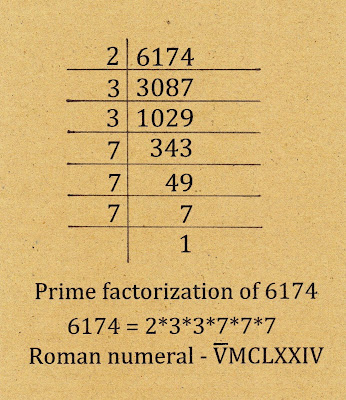
Kaprekar’s constant ( 6174 ) The number 6174 is known as Kaprekar’s constant. The number is named after the Indian Mathematician Dr. D. R. Kaprekar . Now follow the rules given below: Take any 4-digit number ( at least two different digits ). Leading zeroes are allowed. Arrange the digits in descending order and then in ascending order. Now subtract the greater number from the smaller number. Repeat the process until you get the number 6174. You will always end with the number 6174. Example: Let us choose 8967, then 9876 – 6789 = 3087 8730 – 0378 = 8352 8532 – 2358 = 6174 Other properties 6174 is a Harshad number 6174 is 7-smooth number

8128 AND PERFECT NUMBERS

Image
The number 8128 is the most notable perfect number. 8128 = 1 + 2 + 4 + 8 + 16 + 32 + 64 + 127 + 254 + 508 + 1016 + 2032 + 4064 A perfect number is a positive integer that is equal to the sum of its proper divisors not including the number itself, e.g. 28 is a perfect number because 28 = 1 + 2 + 4 + 7 + 14. The numbers 1, 2, 4, 7, 14 are the divisors of 28 i.e. they can divide 28. First perfect number is 6, i.e. 6 = 1 + 2 + 3. Other examples include 496, 8128 etc. It is not discovered that whether there is any odd perfect number or not.  8128 is related to the mersenne prime 127 127 = 2 7 – 1 2 7 – 1 is prime, then 2 7 -1 (2 7 – 1 ) must be a perfect number, i.e. 2 7 -1 (2 7 – 1 ) = 8128 Prime numbers of the form 2 p – 1 are called mersenne primes. Example include 3, 7, 31, 127, 8191, 131071, 524287 etc. Largest known prime number 2 74207281 – 1 is a Mersenne prime. Other features of 8128 are : 8128 is 127 th triangular number 8...

PRINCIPLE OF MATHEMATICAL INDUCTION PART 2

Image
Using principle of mathematical induction prove that 2 n > n for all positive integers n. Let P ( n ): 2 n > n When n = 1, 2 1 > 1. Hence P ( 1 ) is true. Assume P ( k ) is true for any positive integer k, then 2 k > k                                 …( 1 ) Multiply both side of equation ( 1 ) by 2, we get 2.2 k > 2k 2 k + 1 > 2k 2 k + 1 > k + k 2 k + 1 > k + 1. Therefore P ( k + 1 ) is true when P ( k ) is true. Hence by the principle of mathematical induction, P ( n ) is true for all n.

EUCLID'S DIVISION ALGORITHM FOR POLYNOMIALS

Image
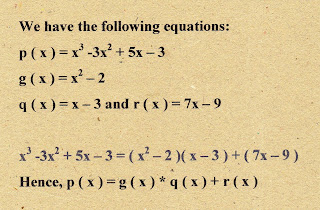
If p ( x ) and g ( x ) are two polynomials such that g ( x ) ≠   0, then you can find polynomials r ( x ) and q ( x )   that are related as following: p ( x ) = g ( x ) ✕ q ( x ) + r ( x ) Where r ( x ) = 0 or degree of r ( x ) < degree of g ( x ) This result is known as Euclid’s Division Algorithm for polynomials. Example: Let p ( x ) = x 3 – 3x 2 + 5x – 3 and g ( x ) = x 2 – 2 Now divide p ( x ) by g ( x ) You will get quotient as q ( x ) = x – 3 and remainder as r ( x ) = 7x - 9

WHAT IS A CONJECTURE

Image
Oxford dictionary definition: An opinion or conclusion formed on the basis of incomplete information. Cambridge dictionary definition: A guess about something based on how it seems and not on proof. Example: Riemann hypothesis, Poincare conjecture, Collatz conjecture etc.

INTEGRAL POWERS OF IOTA ( i )

Image
What is the solution of the equation x 2 + 1 = 0? In fact we don’t have any solution to the given equation in the system of real numbers. Why? Because x 2 + 1 = 0 gives x 2 = -1 and square of every real number is non-negative. Then, what could we do? We need to extend the real number system to a larger system to find the solution of the equation x 2 + 1 = 0. In general, we have to find the solution of the equation ax 2 + bx + c = 0, where D = b 2 – 4ac < 0. Euler was the first mathematician to introduce the symbol i ( Iota ) for the square root of -1, i.e. solution of the equation x 2 + 1 = 0. Now, we have i = √-1 i 2 = -1 i 3 = i 2 * i = -i i 4 = ( i 2 ) 2 = ( -1 ) 2 = 1