Posts

MATHEMATICAL MODELLING
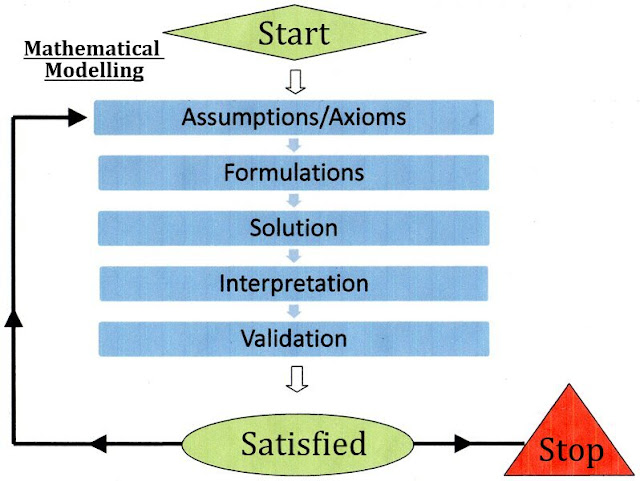
Image
What is mathematical modelling ? Mathematical modelling is an attempt to study some part ( or form ) of the real-life problems in mathematical terms. Conversion of physical situation into mathematics with some suitable conditions is known as mathematical modelling.  Mathematical modelling is nothing but a technique and the pedagogy taken from fine arts and not from the basic sciences. The use of mathematics in solving real-world problems has become widespread especially due to the increasing computational power of digital computers and computing methods, both of which have facilitated the handling of lengthy and complicated problems .  The process of translation of real-life problem into mathematical form can give a better representation and solution of certain problems . Example Suppose a surveyor wants to measure the height of a tower . It is physically very difficult to measure the height using measuring tape . So, the other option is to find o...
THEODOLITES AND THE APPLICATIONS OF TRIGONOMETRY

Image
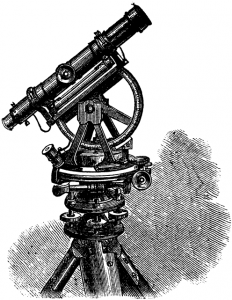
A theodolite ( Application of trigonometry) A theodolite is a instrument used for measuring angles in vertical and horizontal planes. A theodolite is used for the applications of trigonometry such as surveying, navigation, measuring distances etc. A theodolite consist of movable telescope mounted on two perpendicular axes. Surveyors have used trigonometry for centuries. One such large surveying project of the nineteenth century was the 'Great Trigonometry Survey' of British India for which the two largest-ever theodolites were built . During the survey in 1852, the highest mountain in the world was discovered. From a distance of over 160 km , the peak was observed from six different stations. In 1856, this peak was named after Sir George Everest, who had commissioned and first used the giant theodolites . The theodolites are now on display in the Museum of the survey of India in Dehradun .

HEIGHTS AND DISTANCES AND THE APPLICATIONS OF TRIGONOMETRY

Image
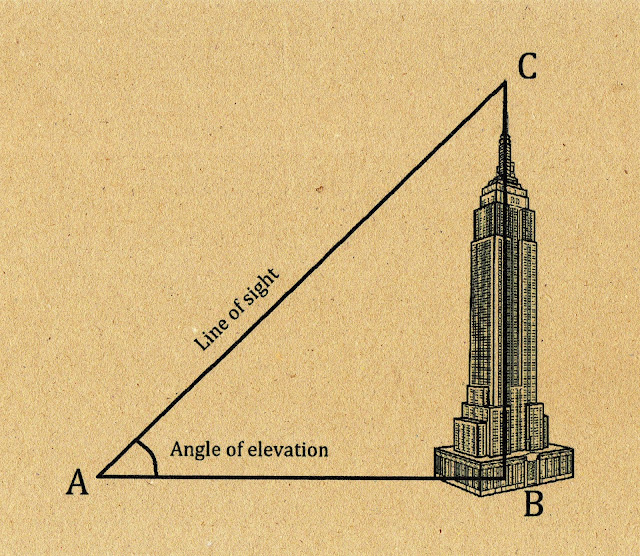
Measuring heights and distances using trigonometry. Trigonometry is also used for finding the heights and distances of various objects, without actually measuring them. To find the distance or height of any object or building etc., you have to calculate the angle of elevation/depression and calculate the distance/height using trigonometric ratios. Some important expressions to keep in mind while solving the above problem of height and distance given below: Line of sight: It is the line drawn from the eye of an observer to the point in the object viewed by the observer. Angle of elevation: This is the angle formed by the line of sight with the horizontal when it is above the horizontal level, i.e., the case when we raise our head to look at the object. Angle of depression: The angle formed by the line of sight with the horizontal when it is below the horizontal level, i.e., the case when we lower our head to look at the object.  Trigonometric ...

FRUSTUM OF A CONE

Image
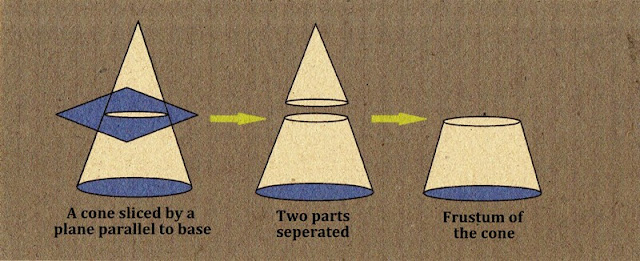
Frustum is a Latin word meaning 'piece cut off', and its plural is 'frusta'. A frustum is a portion of a solid that lie between one or two parallel planes. The frustum of cone has two circular ends with different radii. Take a right circular cone and remove a portion of it. There are many ways in which we can do this. But one particular case that we are interested in it is the removal of a smaller right circular cone by cutting the given cone by a plane parallel to its base. You must have observed that the glasses ( tumblers ) , in general, used for drinking water, are of this shape. Construction of frustum of cone Take some clay, or any other such material ( like plasticine, etc. ) and form a cone.  Cut it with a knife parallel to its base.  Remove the cone that is formed on one side of that plane. The part that now left is a frustum of cone. The frustum of cone has two circular ends with different radii. Let h be the height, l the slant...

GRAPH OF X TO THE POWER 2

Image
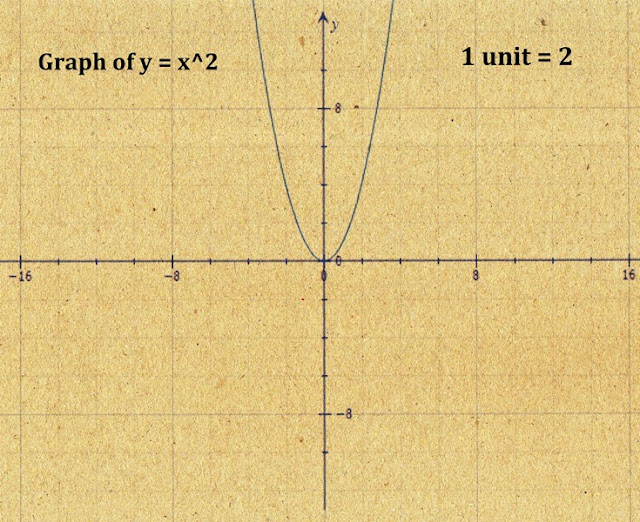
Graph of function  f: R→R by y = f(x) =  x 2  

TRIGONOMETRIC RATIOS OF DIFFERENT ANGLES

Image
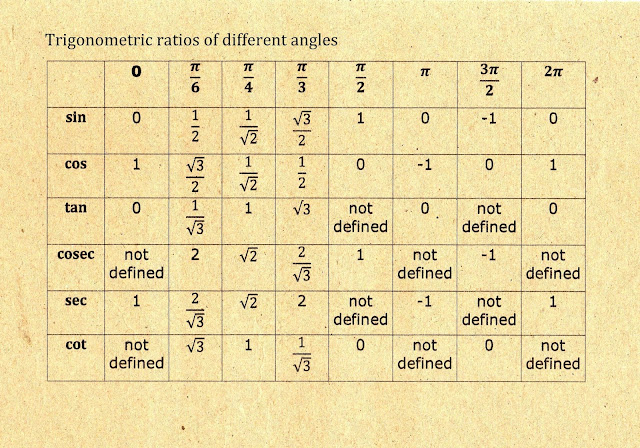
Trigonometric ratios of various angles The values of cosec x, sec x, cot x, are the reciprocal of the values of sin x, cos x, and tan x respectively. 

ANGLES AND ITS DIFFERENT UNITS

Image
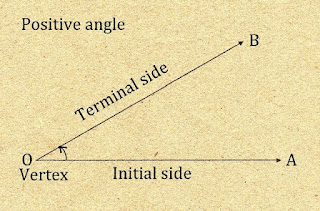
Angle is a measure of rotation of a given ray about its initial point.  The original ray is called the initial side and the final position of the ray after rotation is called the terminal side of the angle. The point of rotation is called the vertex. If the direction of rotation is anticlock, the angle is said to be positive . If the direction of rotation is clock, then the angle is negative . The measure of an angle is the amount of rotation performed to get the terminal side from the initial side. There are several units for measuring angles. Degree measure If a rotation from the initial side to terminal side is ( 1/360 )th of a revolution, the angle is said to have a measure of one degree ( 1° ). A degree is divided into 60 minutes ( 60' ). A minute is divided into 60 seconds ( 60" ). One sixtieth of a degree is called a minute, i.e. 1', and one sixtieth of a minute is called a second, i.e. 1". Thus,     1° = 60' ,  1' = 60...