Posts

SIGNIFICANT FIGURES AND ROUNDING OFF

Image
The number of significant figures in any measurement indicates the degree of precision of that measurement.  The degree of precision is determined by the least count of the measuring instrument. Suppose a length measured by a meter scale  ( of least count = 0.1 cm ) is 1.5 cm, then it has only two significant figures, namely 1 and 5.  Measured with a vernier callipers ( of least count = 0.01 cm ) the same length 1.53 cm and it then has three significant figures. Measured with a screw gauge ( of least count = 0.001 cm ) the same length may be 1.536 cm which has four significant figures.  It must be clearly understood that we cannot increase the accuracy of a measurement by changing the unit .  For example, suppose a measurement of mass yields a value 39.4 kg. It is understood that the measuring instrument has a least count of 0.1 kg.  In this measurement, three figures 3, 9, 4 are significant. If we change 39.4 kg to 39400 g or 3...
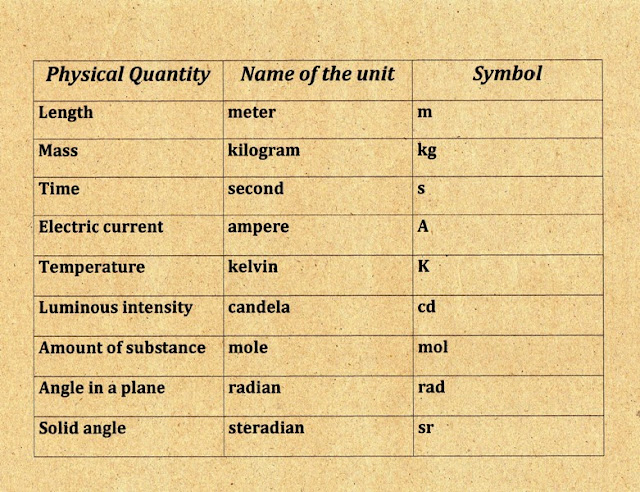

FUNDAMENTAL PHYSICAL QUANTITIES

Image
The internationally accepted standard units of the fundamental quantities.

NARCISSISTIC NUMBERS

Image
Narcissistic number is a number that is the sum of its own digits each raised to the power of the number of digits. Narcissistic numbers also known as Armstrong number , plus perfect number , plusperfect digital invariant Examples 153 = 1 3 + 5 3 + 3 3 370 = 3 3 + 7 3 + 0 3 407 = 4 3 + 0 3 + 7 3

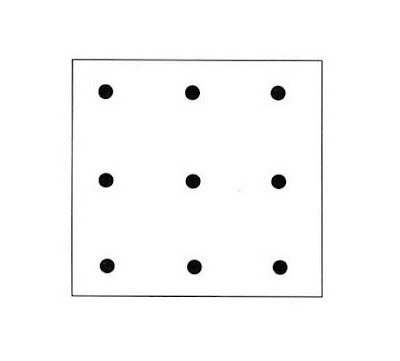
DOT PUZZLE ( CONNECT ALL THE DOTS WITHOUT LIFTING THE PEN AND WITH ONLY FOUR STRAIGHT LINES WITHOUT ANY OVERLAP )

Image
Here we would solve a dot puzzle Consider the figure below Connect all the dots without lifting the pen with only 4 straight lines and the lines do not overlap. Here are some examples already done for you but not been solved because some dots left to be crossed. You could see that some dots have been left to be crossed by the line. So do you think you could solve it. Let us try one more time. Now, what do you see, the puzzle has been solved with the required conditions. Find out some more solutions to this question.

SLOPE OF A LINE

Image
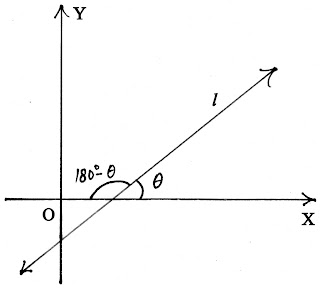
Slope of a line A line in a coordinate plane forms two angles with the x-axis , which are supplementary.  The angle θ made by the line l with positive direction of x-axis and measured anti-clockwise is called the inclination of the line. Obviously 0° ≤ θ ≤ 180°. We observe that line parallel to x-axis, or coinciding with x-axis, have inclination of 0°.  The inclination of a vertical line ( parallel to or coinciding with y-axis ) is 90°. If θ is the inclination of a line l, then tanθ is called the slope or gradient of the line l. The slope of a line having inclination 90°  is not defined. The slope of a line is denoted by m. Thus m = tanθ, θ ≠ 90°. It may be observed that slope of x-axis is zero and slope of y-axis is not defined . Slope of a line when coordinates of any two points on the line are given  Let P ( x, y ) and Q ( x, y ) be two points on a line l with inclination θ. Then slope is given by ...

SPEED OF LIGHT - A UNIVERSAL CONSTANT

Image
Have you ever wondered what is the speed of light ? Well this one of the most interesting questions in the world of Mathematics and Physics . The speed of light in vaccum is a fundamental constant . The most interesting fact about this speed is that if an object moves with this speed in one frame, it has the same speed in any other frame. This the key fact on which the special theory of relativity is based . The speed of light is defined to be exactly 299,792,458 m/s. Perhaps the first attempt to measure the speed of light was made by Galileo . Two experimenter A and B, each having a lantern and a shutter, stands on two small hills.  The shutter can cover or uncover the lantern. Initially, both the lanterns are covered . One of the persons A uncovers his lantern. The second person B uncovers his lantern when he sees the light from the lantern of A. The first person A covers his lantern when he sees the light from the lantern of B.  The time el...

INTERESTING FACT ABOUT A MATHEMATICIAN

Image
Maria Agnesi ( 1718-1799 ) was the first woman to write a Mathematics handbook and the first woman appointed as a Mathematics Professor at a university. She was an Italian Mathematician, pholosopher . She was a sleep walker and could do mathematical problems in her sleep. Often in the morning she would find that she had sleepwalked to her desk and completed a problem she had been unable to solve the last night.