Posts

PRINCIPLE OF MATHEMATICAL INDUCTION PART 2

Image
Using principle of mathematical induction prove that 2 n > n for all positive integers n. Let P ( n ): 2 n > n When n = 1, 2 1 > 1. Hence P ( 1 ) is true. Assume P ( k ) is true for any positive integer k, then 2 k > k                                 …( 1 ) Multiply both side of equation ( 1 ) by 2, we get 2.2 k > 2k 2 k + 1 > 2k 2 k + 1 > k + k 2 k + 1 > k + 1. Therefore P ( k + 1 ) is true when P ( k ) is true. Hence by the principle of mathematical induction, P ( n ) is true for all n.

EUCLID'S DIVISION ALGORITHM FOR POLYNOMIALS

Image
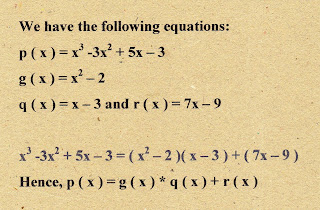
If p ( x ) and g ( x ) are two polynomials such that g ( x ) ≠   0, then you can find polynomials r ( x ) and q ( x )   that are related as following: p ( x ) = g ( x ) ✕ q ( x ) + r ( x ) Where r ( x ) = 0 or degree of r ( x ) < degree of g ( x ) This result is known as Euclid’s Division Algorithm for polynomials. Example: Let p ( x ) = x 3 – 3x 2 + 5x – 3 and g ( x ) = x 2 – 2 Now divide p ( x ) by g ( x ) You will get quotient as q ( x ) = x – 3 and remainder as r ( x ) = 7x - 9

WHAT IS A CONJECTURE

Image
Oxford dictionary definition: An opinion or conclusion formed on the basis of incomplete information. Cambridge dictionary definition: A guess about something based on how it seems and not on proof. Example: Riemann hypothesis, Poincare conjecture, Collatz conjecture etc.

INTEGRAL POWERS OF IOTA ( i )

Image
What is the solution of the equation x 2 + 1 = 0? In fact we don’t have any solution to the given equation in the system of real numbers. Why? Because x 2 + 1 = 0 gives x 2 = -1 and square of every real number is non-negative. Then, what could we do? We need to extend the real number system to a larger system to find the solution of the equation x 2 + 1 = 0. In general, we have to find the solution of the equation ax 2 + bx + c = 0, where D = b 2 – 4ac < 0. Euler was the first mathematician to introduce the symbol i ( Iota ) for the square root of -1, i.e. solution of the equation x 2 + 1 = 0. Now, we have i = √-1 i 2 = -1 i 3 = i 2 * i = -i i 4 = ( i 2 ) 2 = ( -1 ) 2 = 1

LINEAR INEQUALITIES AND ITS REPRESENTATION

Image
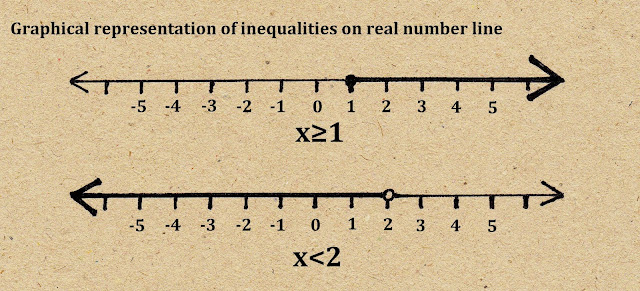
Definition of linear inequality  A statement involving two real numbers or two algebraic expressions related by the symbol ' < ', ' > ', ' ≤ ', ' ≥ ' form an inequality. Types of inequalities Numerical inequalities, e.g. 7 > 5, 11 < 8 etc. Literal inequalities, e.g. x < 7, y > 4, x ≥  6 etc. Double inequalities, e.g. 3 ≤ x < 5, 6 < y < 11 etc. Strict inequalities, e.g. x < 7, ax + by > 0 etc. Slack inequalities, e.g. ax + by ≤ 0 Quadratic inequalities, e.g. ax^2 + bx + c > 0 etc. Rules for solving an inequality Rule 1: Equal numbers may be added to ( or subtracted from ) both sides of an inequality without affecting the sign of inequality. Rule 2: Both sides of an inequality can be multiplied ( or divided ) by the same positive number. But when both sides are multiplied or divided by a negative number, then the sign of inequality is reversed. Representation of inequality on real number line

FUNCTIONS

Image
Function Function is a special type of relation. It is one of the most important concepts in mathematics.The word function is derived from a Latin word meaning operation and the word mapping and map are synonimous to it. Functions play very important role in Calculus. A relation f from a set A to a set B is said to be a function if every element of set A has one and only one image in set B. In other words, a function f is a relation from a non-empty set A to a non-empty set B such that the domain of f is A and no two distinct ordered pairs in f   have the same first element . If f is a function from from A to B and ( a, b ) ∈ f , then f  ( a )  = b, where b is called the image of a under f and a is called the preimage of b under f . The function f  from A to B is denoted by f  : A ⟶ B. A function which has either R ( real numbers ) or one of its subsets as its range is called a real valued function. Further, if its domain is also either R ( rea...

RELATIONS

Image
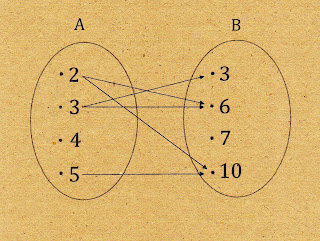
Relations A relation R from a non-empty set A to a non-empty set B is a subset of the cartesian product         A Х B . The subset is derived by describing a relationship between the first element and the second element of the ordered pairs in A Х B. The second element is called the image of the first element. The set of all first elements of the ordered pairs in a relation R from a set A to a set B is called the domain of the relation R. The set of all second elements in a relation R from a set A to a set B is called the range of the relation R. The whole set B is called the codomain of the relation R.  Range ⊆ codomain . Example Let A = { 2, 3, 4, 5 } and B = { 3, 6, 7, 10 } . A relation R from set A to the set B as follows: R = { ( x, y ) : x divides y, where x ∈ A and y ∈ B }. We find that 2 divides 6 and 10, 3 divides 3 and 6, 5 divides 10 and there is no number in B that can be divided by 4. Thus ( 2, 6 ) ∈ R, ( 2, 10 ) ∈ R, ( 3, 3...